
Psychology
Trading Psychology for Prop Firm Challenges: Why Evaluation Rules Change How You Trade
· 9 min read · By Holdy Lab
A prop firm challenge looks like a trading test. In practice it's a behavioral test wearing a trading costume: the same strategy that works fine on a normal account can fail an evaluation, not because the market moved against it, but because the evaluation's own rules — a daily loss limit, a trailing drawdown, a deadline — change how a trader responds to being up or down. This article looks at what the data says about who actually gets funded, what the research says about how fixed rules and deadlines change risk-taking, and how to prepare for the psychology of an evaluation before you pay for one.
What actually happens to 100 people who buy a challenge
Finance Magnates obtained data from FPFX Tech, a technology provider used by prop trading firms, covering more than 300,000 accounts belonging to 100,000 traders across 10 firms. Justin Hertzberg, FPFX Tech's founder and CEO, put the funnel in exact numbers: "14% of traders passed the challenge and obtained a funded account. Of those, about 45% achieved a payout (7% of all traders) in their funded account, with the average payout being 4% of the plan size." A single account spends roughly $800 on challenge fees across its lifetime, typically across three attempts.
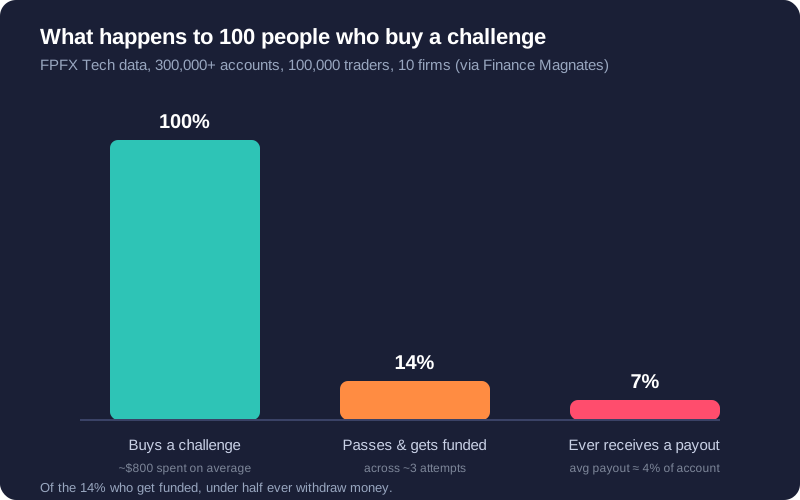
People who pay for a challenge are not a random sample of traders — they're self-selected and motivated enough to put money down. A 14% pass rate among that group is not a statement about how hard it is to find a profitable trade. It's a statement about how hard it is to keep trading the same way once an evaluation's rules are watching every day of it.
The rules that make an evaluation different from ordinary trading
Nearly every funded-trader program is built around the same three constraints, whatever the firm calls them: a daily loss limit that ends the day the moment it's hit, a maximum or trailing drawdown that ends the whole evaluation the moment it's hit, and a fixed time window to hit a profit target inside both. None of these exist on an ordinary personal account. They don't change what a good trade looks like — they change what happens in a trader's head on the days a position is going the wrong way.
Falling behind a target raises risk — a pattern documented outside trading too
Chevalier and Ellison (1997) studied mutual fund managers facing a comparable structure: a fixed evaluation period (the calendar year) and a target they're judged against (the benchmark, and rival funds). They found that funds running behind their peers at mid-year reliably increased portfolio risk in the second half, trying to close the gap before the year — their evaluation window — closed. Funds that were ahead did the opposite: they took risk off to protect the lead.
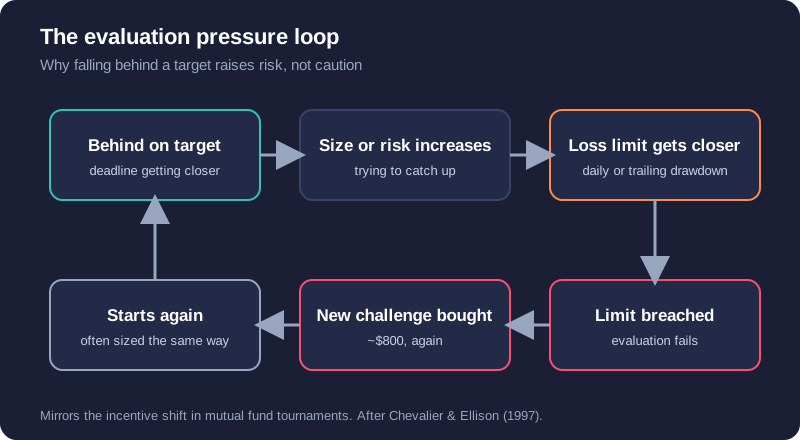
A prop firm evaluation is the same incentive geometry, compressed from a year into days or weeks: a trader behind on the profit target with the window closing faces exactly the pull Chevalier and Ellison documented — size up, trade more, close the gap. The difference is that a mutual fund manager who swings for it and misses keeps their job. A trader who swings for it and misses a daily or trailing loss limit doesn't get a second half of the year to try again — the evaluation just ends.
Daily loss limits create a new "zero" every day
A daily loss limit does something subtle to how a trader frames the day: it turns each session into its own small account that resets to zero every morning. Thaler and Johnson (1990) described exactly this kind of reference-point shift in the break-even effect — once someone is down for a period, they take on more risk specifically to get back to even before that period closes, more risk than they'd accept starting from zero. A trader down for the day with a hard daily loss limit a few hundred dollars away isn't just managing a losing position; they're managing the psychological pull to erase the loss before the clock resets it anyway — the same mechanism covered in more detail in the break-even effect and revenge trading.
What actually separates the traders who pass
It's tempting to assume the traders who get funded are simply better at reading the market. Locke and Mann (2005) studied professional futures floor traders at the Chicago Mercantile Exchange — people trading for a living, under real performance pressure, closer to a funded prop account than a retail investor — and found that measures of trading discipline predicted subsequent success better than any read on market direction. The traders who lasted weren't the ones who avoided losing trades; they were the ones who were more consistent about how they handled losing trades.
That lines up with how evaluations actually end. A trader doesn't usually fail by being wrong about the market — being wrong about one trade rarely breaches a daily loss limit on its own. Evaluations end when a string of normal-sized losses gets followed by one oversized reaction to them: the size increase from the loop above, arriving right when there's the least room left to absorb it.
What to check before you pay for a challenge
- Test the strategy against the firm's actual numbers first — its daily loss limit, trailing drawdown and profit target as percentages of account size — not against how the strategy performs with no constraints at all.
- Track whether position size changes after a losing session, specifically. If it does on a normal account, a firm's daily reset will trigger the same pattern, just with a hard rule standing where a bad habit used to be the only cost.
- Watch for the specific moment risk-taking tends to rise: being behind the profit target with the evaluation window closing. That's the exact condition the research above says raises risk-taking — plan the response to it before it happens, not during it.
- Treat the cost of an attempt (challenge fees, resets) as a real number before buying one. At roughly $800 spent per account across about three attempts industry-wide, the honest first question is whether a strategy is tested enough to be worth that, not whether this attempt feels like the one.
- If the firm uses a consistency rule, don't let one outsized green day feel like progress — it can lock up a payout until it's offset by slower, steadier days, which is the opposite of what the pressure in the moment is pushing for.
How Holdy helps you rehearse this before you pay for a challenge
Strategy Lab lets you set a daily loss limit and a leverage level and run the strategy through optimistic, base and pessimistic scenarios before any of it is real — so the gap between "this strategy works" and "this strategy survives a hard daily loss limit" shows up on a test run, not on day six of a challenge you already paid for.
Trader Day's Two-Loss Pause and daily trade-count limits mirror the kind of hard rule a funded account imposes, in a session where missing the rule costs nothing. And because Holdy records what you planned against what you actually did, Plan vs Execution shows whether your size or frequency crept up after a loss — the exact discipline gap Locke and Mann found separates traders who last from traders who don't.
Educational content, not financial advice. Prop firm evaluations and funded-account programs carry fees and rules set by each firm, not by Holdy Lab; this article describes general patterns in evaluation structures and trading psychology, not the terms of any specific program.
Sources
- FPFX Tech data via Finance Magnates, Exclusive: Only 7% of 300,000 Prop Trading Accounts Achieved Payouts
- Chevalier & Ellison (1997), Risk Taking by Mutual Funds as a Response to Incentives, Journal of Political Economy
- Thaler & Johnson (1990), Gambling with the House Money and Trying to Break Even, Management Science
- Locke & Mann (2005), Professional Trader Discipline and Trade Disposition, Journal of Financial Economics
See your own patterns
Play a free simulated trading session and get a behavioral debrief — no signup, no real money.
Start Trader DayKeep reading
Holdy Lab content is educational and is not financial advice. Simulated results do not predict real results.