Psychology
Why Most Retail Traders Lose: It's Behavior, Not Information
· 6 min read · By Holdy Lab
Most people who try active trading believe their problem is missing knowledge: a better indicator, a better setup, a better source of news. The research on individual traders points somewhere less comfortable. The gap between what traders know and what they do — trading psychology — explains far more of the outcome than the next piece of information.
What the data on individual traders shows
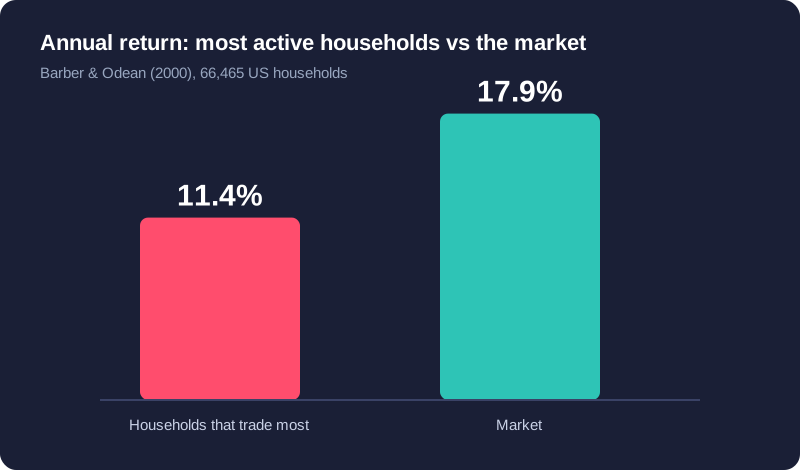
In a study of 66,465 US households, Barber and Odean (2000) found that the households that traded most earned an annual return of 11.4 percent while the market returned 17.9 percent. The households were not short of information. They paid for their activity in costs and in decisions that did not pay off.
The same pattern shows up at the extreme end. Chague, De-Losso and Giovannetti followed everyone who started day trading Brazilian equity index futures between 2013 and 2015. Among those who persisted for more than 300 days, 97 percent lost money, and only 1.1 percent earned more than the Brazilian minimum wage.
A study of day traders in Taiwan by Barber, Lee, Liu and Odean adds a detail that matters here: the aggregate performance of day traders was negative every year, and many unprofitable traders kept trading at nearly the same rate as profitable ones. They did not learn the lesson their results were teaching.
Why the problem is behavioral
If losses came from a lack of information, more information would fix them. But the losing traders in these datasets had access to the same prices and news as everyone else. What differed was how they acted on it: trading too often, holding losers, and repeating what did not work. The US Securities and Exchange Commission makes a similar point: most individual investors do not have the wealth, the time or the temperament for day trading.
Temperament is the key word. Lo, Repin and Steenbarger (2005) had 80 day traders report their emotional state daily for five weeks. Traders whose emotional reactions to gains and losses were more intense performed significantly worse. They also found no single "trader personality" that predicted success, which suggests that the relevant skills are learnable rather than innate.
What to do with this
If behavior is the problem, the fix is to make your behavior visible. Not your profit and loss for the day, but the decisions behind it: how big you trade after a loss, whether you follow your own stop-loss, how long you wait before re-entering, how your discipline changes between calm and volatile markets.
- Record decisions with context (plan, size, stop, state), not just results.
- Look for patterns across many decisions instead of judging single trades.
- Change one behavior at a time and check whether the pattern moved.
- Practice in a low-stakes environment first, such as paper trading or a crypto trading simulator, where mistakes cost nothing but still leave a record.
This article is educational and is not financial advice. Trading, especially with leverage, involves a substantial risk of loss.
Sources
- Barber & Odean (2000), Trading Is Hazardous to Your Wealth, Journal of Finance
- Chague, De-Losso & Giovannetti, Day Trading for a Living?, SSRN
- Barber, Lee, Liu & Odean, Do Day Traders Rationally Learn About Their Ability?
- Lo, Repin & Steenbarger (2005), Fear and Greed in Financial Markets, American Economic Review
- U.S. SEC, Day Trading: Your Dollars at Risk
See your own patterns
Play a free simulated trading session and get a behavioral debrief — no signup, no real money.
Start Trader DayKeep reading
Holdy Lab content is educational and is not financial advice. Simulated results do not predict real results.