Guides
How to Practice Crypto Trading Without Risking Real Money
· 8 min read · By Holdy Lab
The cheapest way to learn is to make your mistakes where they cost nothing. Paper trading and demo trading in a crypto trading simulator let you practice decisions, test a plan and see how you behave under pressure before real money is involved. The catch is that practice only helps if you practice the right things.
Why practice first
The evidence on beginners is sobering. The SEC notes that day traders often suffer severe losses in their first months, and in the Brazilian futures data studied by Chague and colleagues, most persistent day traders lost money. Learning from your own mistakes is much cheaper in a simulator than in a live account.
Practice deliberately, not casually
Ericsson and colleagues (1993) found that expert performance comes from deliberate practice: specific goals, focused effort and feedback. Applied to demo trading, that means: pick one skill per session (for example, respecting a stop), keep a record, and review what happened rather than only how much the balance moved.
The basics to practice
What is position sizing?
Position sizing is deciding how much to put into a trade. A common approach is to fix the amount you are willing to lose on a trade as a small percentage of your account, then let the stop-loss distance determine the size. It keeps one bad trade from ending your session.
What is leverage?
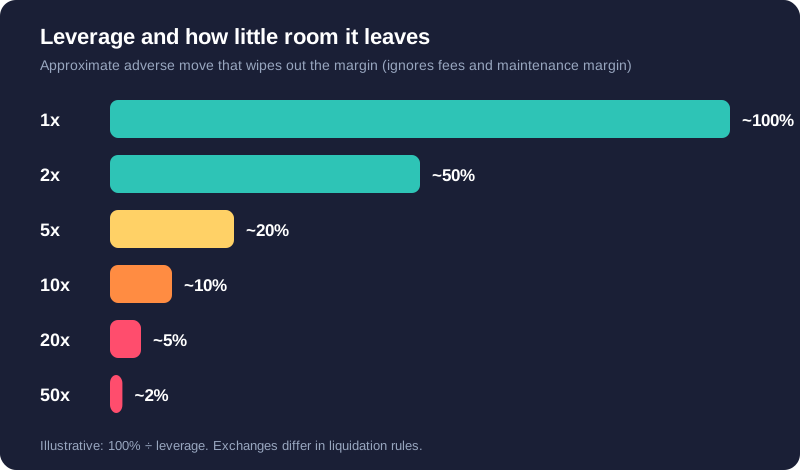
Leverage lets you control a position larger than your own capital by borrowing. It multiplies gains and losses alike, and it shrinks the room a price has to move against you before the position is closed for you.
What is liquidation?
Liquidation is the forced closing of a leveraged position when losses use up the margin backing it. As a rough rule, the adverse move that wipes out your margin is about 100% divided by your leverage, before fees and maintenance margin. Exchanges differ in how they calculate this.
What is a stop-loss?
A stop-loss is a predefined exit if price moves against you. In crypto, where moves can be fast, deciding your stop before you enter is a basic part of risk management. What you should measure in practice is not whether stops exist but whether you honor them.
How to structure your practice
- Start with low leverage and a fixed maximum position size, and only raise them after you have followed the rules for several sessions.
- Practice different market conditions: calm, trending, choppy, volatile and news-shock days behave differently, and so will you.
- Set a session limit for trades and for loss, and see whether you keep to them.
- After each session, write what you planned, what you did and where they differed.
- Change one behavior at a time.
Know the limits of paper trading
Simulation does not fully reproduce how real money feels. Emotions are usually milder when nothing is at stake, and fills, fees and slippage in a live market can differ from a demo. Treat a simulator as a place to build process and self-knowledge, not as proof that a strategy will make money. A good simulator therefore focuses on decisions under pressure rather than on a flattering profit number.
Educational content, not financial advice. Trading crypto and using leverage carries a high risk of loss.
Sources
See your own patterns
Play a free simulated trading session and get a behavioral debrief — no signup, no real money.
Start Trader DayKeep reading
Holdy Lab content is educational and is not financial advice. Simulated results do not predict real results.