Psychology
Why You Hold Losers and Sell Winners: Loss Aversion in Trading
· 6 min read · By Holdy Lab
You close a small winner in a hurry and hold a loser for days, hoping it comes back. It feels like patience. In trading psychology it has a name — the disposition effect — and it is one of the best documented behaviors of individual investors.
Losses weigh more than gains
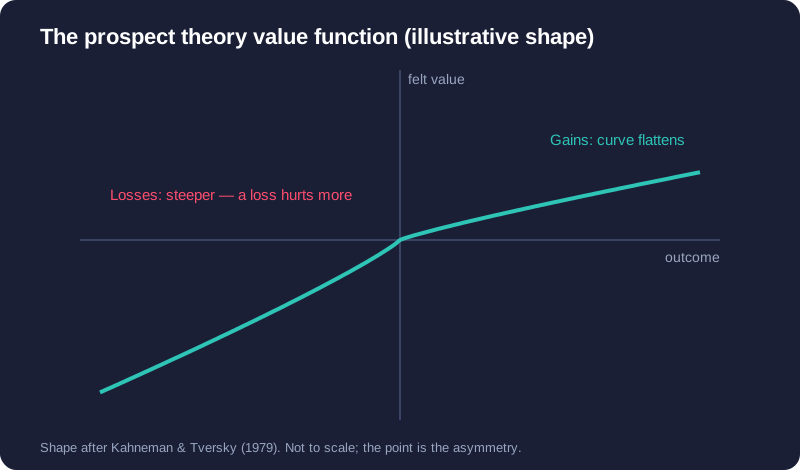
In Prospect Theory, Kahneman and Tversky (1979) described how people evaluate outcomes relative to a reference point, and how losses loom larger than equivalent gains. The value curve is steeper below the reference point than above it, so the pain of losing 100 is greater than the pleasure of winning 100.
From a curve to a trading habit
Shefrin and Statman (1985) named the resulting tendency the disposition to sell winners too early and ride losers too long. Locking in a gain feels good. Realizing a loss feels like admitting a mistake, so we wait for it to "come back".
Odean (1998) tested this on the records of 10,000 brokerage accounts and found that investors tend to hold losing investments too long and sell winning investments too soon. It is not a beginner's error. It is a default of human decision-making, which is why it needs a system rather than willpower.
How to see it in your own data
- Compare your average time in winning trades with your average time in losing trades. Holding losers noticeably longer is the classic signature.
- Check how often you move or remove a stop-loss after entering. Every change made while in a loss is a data point.
- Compare your average win with your average loss. Cutting winners early and letting losers run shrinks the ratio.
What helps
The remedy is to move the decision away from the moment of pain. Set the stop-loss before you enter, when you are calm, and treat it as part of the plan rather than a suggestion. In crypto trading, where leverage can turn a modest move against you into a large loss, a predefined stop-loss is a risk-management basic, not an advanced technique. Then measure whether you honor it. Adherence to your own stop is one of the most useful numbers a trader can track.
Educational content, not financial advice. Leveraged crypto trading can lose more than you expect.
Sources
See your own patterns
Play a free simulated trading session and get a behavioral debrief — no signup, no real money.
Start Trader DayKeep reading
Holdy Lab content is educational and is not financial advice. Simulated results do not predict real results.