Psychology
Revenge Trading: Why Risk Rises After a Loss (and How to Break the Loop)
· 6 min read · By Holdy Lab
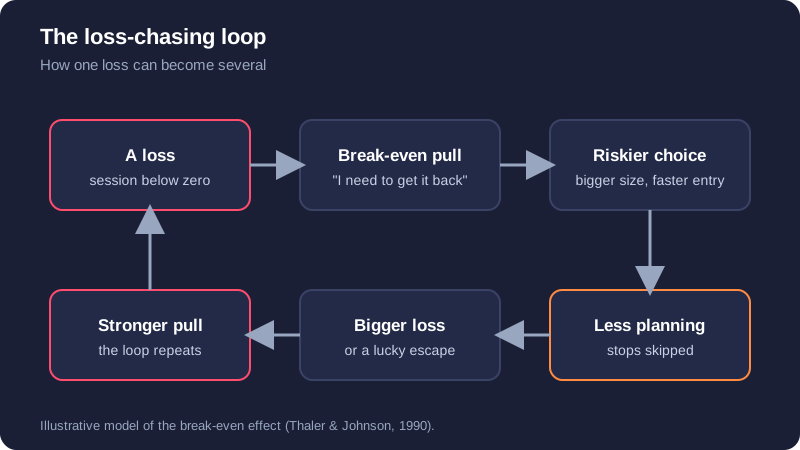
The trade goes wrong, and within a minute you are in another one — bigger, faster, with a looser stop. Traders call it revenge trading. Behavioral research calls a close relative of it the break-even effect. Both describe the same thing: risk that rises exactly when it should fall.
Prior outcomes change how much risk we take
Thaler and Johnson (1990) showed that prior outcomes shape later risky choices. After gains people become more willing to take risk (the house money effect). After losses, the prospect of getting back to even makes gambles that offer a chance to break even unusually attractive — the break-even effect.
Emotion, intensity and results
The emotional side is measurable. In their study of 80 day traders, Lo, Repin and Steenbarger found that traders whose emotional responses to gains and losses were stronger performed significantly worse. The point is not to feel nothing. It is that strong reactions push decisions away from the plan.
What revenge trading looks like in data
- Time to the next entry after a loss is much shorter than your normal gap.
- Position size after a loss is larger than after a win.
- Stop-losses are skipped or widened right after a loss.
- The session is below breakeven and the number of trades climbs.
None of these is visible in a profit-and-loss total. All of them are visible if you record when you enter, how big you trade and whether you set a stop.
Breaking the loop
Trading discipline here is mostly about rules that act before emotion does. Three that follow directly from the pattern:
- A cooldown: after a losing trade, step away for a fixed time (for example five minutes) before considering another.
- A size cap: no position larger than your normal maximum, especially after a loss. This is core risk management for crypto, where leverage amplifies mistakes.
- A daily loss limit: when it is hit, you are done for the day. Decide the number in advance.
Written as if-then rules (see the article on implementation intentions), these become far easier to follow at the moment they matter.
Educational content, not financial advice.
Sources
See your own patterns
Play a free simulated trading session and get a behavioral debrief — no signup, no real money.
Start Trader DayKeep reading
Holdy Lab content is educational and is not financial advice. Simulated results do not predict real results.