Practice
If-Then Rules: Turn Trading Insight into Discipline
· 5 min read · By Holdy Lab
You have found the pattern: you size up after losses. Knowing it does not stop it. Between insight and behavior sits a gap, and psychology has a well-studied tool for closing it: the if-then plan.
What an implementation intention is
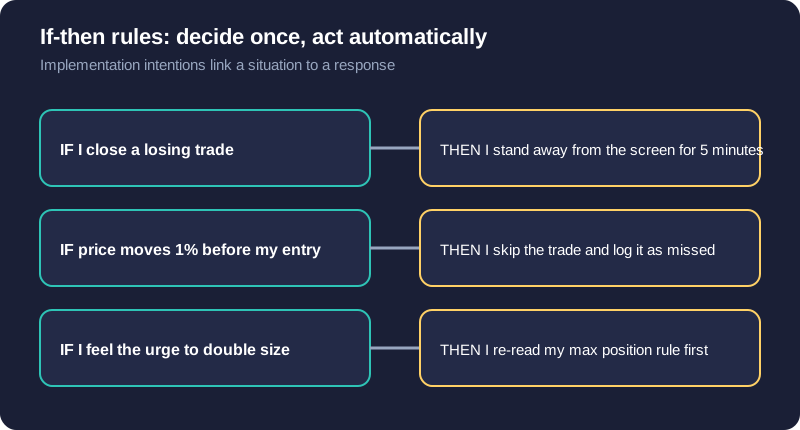
Gollwitzer (1999) reviewed evidence for implementation intentions: plans of the form "if situation X occurs, then I will do Y". The paper's title says it: simple plans have strong effects. By linking a specific situation to a specific response in advance, you turn a decision that needs willpower into one that is closer to automatic.
A later meta-analysis by Gollwitzer and Sheeran (2006)38002-1) pooled many studies of implementation intentions and goal achievement, and it supports the same conclusion.
Good rules are specific and checkable
- Name a trigger you can recognize in the moment ("I close a losing trade"), not a mood ("if I feel emotional").
- Name one concrete response ("I stand away from the screen for five minutes").
- Make it binary: at review time you can say yes or no.
- Limit yourself to one or two rules at a time.
Rules mapped to common patterns
- Revenge trading → "If I close a loss, then I wait five minutes and re-read my plan before the next trade."
- Chasing a move (FOMO) → "If price has already moved 1% since my signal, then I skip and log it as missed."
- Oversizing → "If I want to increase size, then I first check it against my maximum position rule."
- Moving stops → "If price approaches my stop, then I do nothing; the stop stays where I put it."
Test the rule like a hypothesis
Treat each rule as an experiment. Follow it for a fixed number of sessions, record how often you kept it, and look at the behavior it targets. If the pattern shrinks, keep the rule. If you never follow it, it was probably too vague or too large. Shrink it and try again.
Educational content, not financial advice.
Sources
See your own patterns
Play a free simulated trading session and get a behavioral debrief — no signup, no real money.
Start Trader DayKeep reading
Holdy Lab content is educational and is not financial advice. Simulated results do not predict real results.