
Psychology
Overconfidence in Trading: When Confidence Becomes a Cost
· 8 min read · By Holdy Lab

Confidence is supposed to be earned — you get better at something, and you trust yourself more with it. In trading, the research shows something stranger: confidence often grows faster than skill does, and the gap between the two is expensive. Overconfidence is not a personality flaw reserved for reckless beginners. It is a well-documented, measurable pattern in how people trade, and it shows up in account statements as clearly as it shows up in how someone talks about their own edge.
What overconfidence looks like in the data
Barber and Odean (2001) studied over 35,000 households at a discount brokerage between 1991 and 1997 and used a well-established finding from psychology — that men tend to be more overconfident than women in domains like finance — to test a clean prediction: more overconfident traders should trade more, and trade more should mean lower net returns. Both held. Men traded 45% more than women, and that extra trading cut men's net annual returns by 2.65 percentage points, against 1.72 points for women. Among single investors the gap was starker still: single men traded 67% more than single women and earned 2.3% less per year on a risk-adjusted basis.
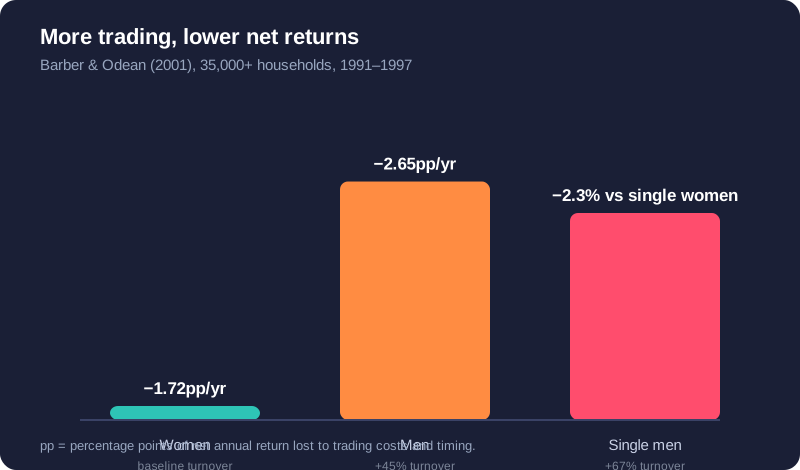
The point of the study was never that one group is worse at investing. It was that overconfidence is the mechanism: believing you know more than the market does is exactly what makes trading a lot feel reasonable, and trading a lot is what erodes the return.
Confidence about volume, not accuracy
A natural objection: maybe confident traders trade more because they really are better, and the extra activity is them acting on real edge. Glaser and Weber (2007) tested this directly. They surveyed around 3,000 online brokerage clients on several measures of overconfidence — including how well-calibrated their predictions were and whether they rated themselves better than average — and matched the answers to the actual trading records of 215 of them.
Two results stood out. First, investors who believed they were above average — despite not having above-average past performance — traded more. Second, and more surprising: how well-calibrated someone's predictions actually were had no measurable relationship with how much they traded. In other words, the trading was driven by the story people told themselves about their skill, not by any real signal of skill.
Confidence rises after wins — and pushes trading up with it
Statman, Thorley and Vorkink (2006) found that trading volume across the market rises in the months after strong returns, and falls after weak ones. Their explanation is biased self-attribution: a win gets credited to skill, so confidence goes up and trading follows; a loss gets blamed on bad luck or bad timing, so confidence rarely comes back down to match. The pattern rhymes with the house money effect — gains loosening risk-taking — but the mechanism here runs through confidence and trading frequency specifically, not just position size.
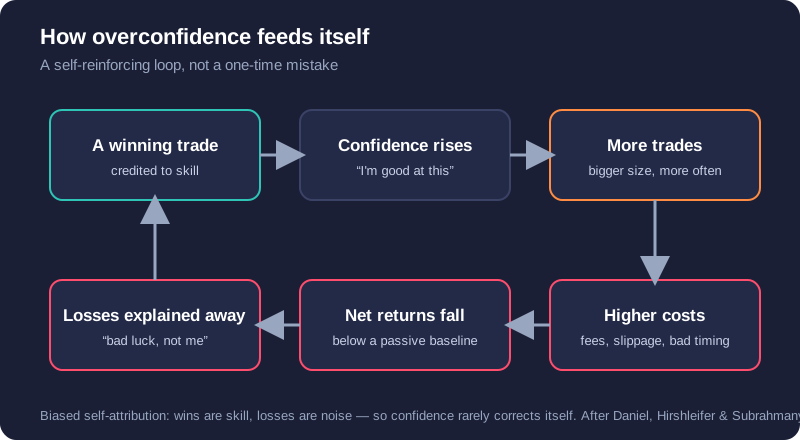
Daniel, Hirshleifer and Subrahmanyam (1998) built a model of exactly this asymmetry: investors overweight their own private information and, because they attribute good outcomes to their own judgment and bad ones to external noise, their confidence doesn't self-correct the way a purely rational learner's would. The loop above is a plain-language version of that model — a win pushes confidence and trading volume up, a loss gets explained away instead of pulling them back down.
Why this matters more with leverage
None of the studies above involve leverage — they're built on ordinary stock accounts. Overconfidence in a crypto account with leverage compounds the same mechanism twice: it makes a trader more willing to enter, and separately more willing to size up once in. A miscalibrated sense of "I know where this is going" doesn't just add an extra trade to the count; sized wrong, it adds a trade that can end the session. This is one reason position sizing rules matter more than a trader's read on the market, not less.
Overconfidence and confirmation bias travel together
Overconfidence rarely shows up alone. Once someone is sure of a view, they tend to notice information that supports it and discount information that doesn't — a pattern documented across decades of psychology research and summarized by Nickerson (1998) as one of the most consistently observed biases in how people process evidence. In trading this looks like reading a bearish chart as a buying opportunity because you already decided to go long, or dismissing a stop-loss hit as "the market being wrong" instead of the trade being wrong.
The two biases reinforce each other in a specific way: overconfidence supplies the initial conviction, and confirmation bias protects that conviction from the evidence that would normally correct it. A trader who is sure of a direction is less likely to register the signals that say otherwise — which is exactly when a stop-loss, not a second opinion from yourself, needs to do the work.
What to check in your own decisions
- Trade frequency after a win versus after a loss — does it rise faster than it falls?
- Position size on trades where you felt "very sure" versus trades where you didn't — is the size actually bigger, or does it just feel more justified afterward?
- How you explain your last three losses: were any of them "bad luck" or "the market being irrational" rather than a plan issue?
- Whether you can name, before entering, what would prove the trade wrong — not just what would prove it right.
A cheap way to separate skill from confidence
Because Glaser and Weber found that calibration and trading volume aren't linked, the fix isn't to feel less confident — it's to test the confidence against something outside your own head before it turns into size or frequency. Two low-cost habits do most of the work:
- Declare the view before you act. Write the direction and the reason down first, the same way Strategy Lab asks for a plan before a test runs — a declared view is checkable later; a view formed after the fact always looks smarter than it was.
- Track calibration, not just outcomes. When you were "very confident," how often were you actually right? Most traders have never checked this number, and it's usually lower than it feels.
Educational content, not financial advice. Trading crypto, especially with leverage, involves a substantial risk of loss.
Sources
- Barber & Odean (2001), Boys Will Be Boys: Gender, Overconfidence, and Common Stock Investment, Quarterly Journal of Economics
- Glaser & Weber (2007), Overconfidence and Trading Volume, Geneva Risk and Insurance Review
- Statman, Thorley & Vorkink (2006), Investor Overconfidence and Trading Volume, Review of Financial Studies
- Daniel, Hirshleifer & Subrahmanyam (1998), Investor Psychology and Security Market Under- and Overreactions, Journal of Finance
- Nickerson (1998), Confirmation Bias: A Ubiquitous Phenomenon in Many Guises, Review of General Psychology
See your own patterns
Play a free simulated trading session and get a behavioral debrief — no signup, no real money.
Start Trader DayKeep reading
Holdy Lab content is educational and is not financial advice. Simulated results do not predict real results.