
Guides
What Is Liquidation in Crypto Trading? Leverage, Risk and What the Data Shows
· 9 min read · By Holdy Lab
Leverage is the fastest way to turn a small account into a large position — and the fastest way to turn a normal price move into the end of your session. Liquidation is not a rare edge case in leveraged crypto trading; it is a routine, well-documented outcome, with regulators and researchers publishing real numbers on how often it happens and why. This article lays out what leverage and liquidation actually are, what the data shows about leveraged retail trading, and how to size a position so a single move can't decide your outcome for you.
What is leverage?
Leverage lets you open a position larger than the cash you put up, by borrowing the rest from the exchange. 10x leverage means a $100 deposit controls a $1,000 position. It multiplies gains and losses by the same factor — and it shrinks, by that same factor, how far the price can move against you before your position is closed.
What is liquidation?
Liquidation is the forced closing of a leveraged position when losses use up the margin (the deposit) backing it. It is automatic: the exchange closes the position to stop your loss from exceeding what you put up, whether or not you're watching the screen. As a rough rule, the adverse move that triggers it is about 100% divided by your leverage — before fees, funding payments and the maintenance-margin buffer exchanges hold back, all of which bring the real number in sooner.
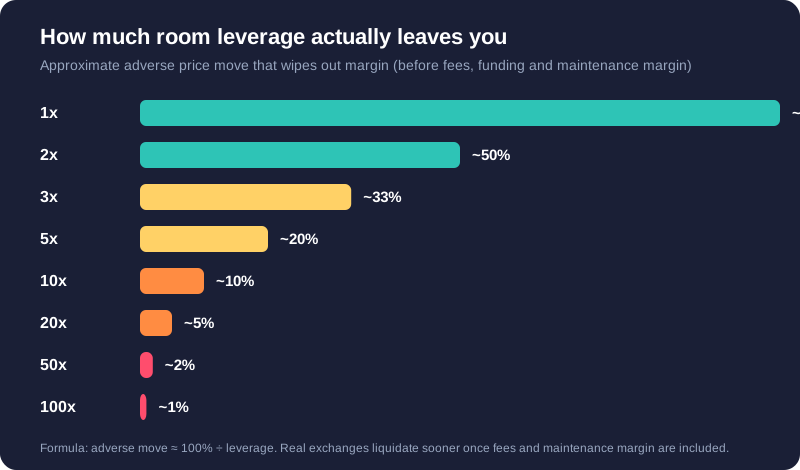
At 10x, an ordinary 10% move against you is enough. At 50x, it's 2% — well within a single volatile hour for most crypto pairs. This is arithmetic, not a prediction: it is exactly what leverage means, and it applies whether the trader is right about direction or not, because it's a statement about how much room for error is left, not about which way the price goes.
What do regulators' numbers say about leveraged trading?
Crypto exchanges mostly sit outside the regulatory perimeter that produced this data, but the underlying product — a leveraged derivative sold to retail traders — is the same mechanism, and regulators have measured its outcomes directly rather than estimating them. The European Securities and Markets Authority reviewed national regulators' data on leveraged contract-for-difference accounts across the EU and found that "74-89% of retail accounts typically lose money on their investments," with "average losses per client ranging from €1,600 to €29,000." This wasn't a survey or a model — it was account-level data from the brokers themselves, which is why it became the basis for the standardized risk warning now shown on every regulated leveraged-trading platform in Europe.
The mechanism ESMA cited behind those losses is leverage itself, alongside product complexity and cost structure. Nothing about that mechanism is specific to CFDs — it's the same one at work whenever a retail account trades a leveraged derivative, crypto included.
What does research say about crypto liquidations specifically?
Qin, Zhou, Gamito, Jovanovic and Gervais (2021) ran the first large-scale empirical study of liquidations across Aave, Compound, MakerDAO and dYdX — lending markets that together made up more than 85% of Ethereum's lending activity at the time. Their finding was blunt: existing liquidation designs "well incentivize liquidators but sell excessive amounts of discounted collateral at the borrowers' expenses." Liquidation isn't a neutral technical event; it's built to protect the protocol and reward whoever closes your position, not to minimize what it costs you.
On the derivatives side, Alexander, Deng and Zou (2021) point out that crypto exchanges typically offer very high leverage with little regulatory oversight, and that most of them liquidate futures positions automatically the moment margin requirements aren't met — no phone call, no grace period, no discretion. Their paper builds a hedging strategy that explicitly treats liquidation probability as a second objective alongside variance, worth minimizing on its own — which is itself a tell: for a professional, avoiding liquidation is something you optimize for, not something you hope avoids you.
Why leverage makes behavioral risk worse, not just financial risk
Leverage doesn't just shrink your room for error mathematically — it interacts with exactly the biases already covered on this site. Overconfidence makes a trader want to size up on a view they're sure of; leverage is the tool that lets them. The house money and break-even effects push risk-taking up right after a win or a loss; leverage is what turns that impulse into a position that can end the session in minutes instead of hours.
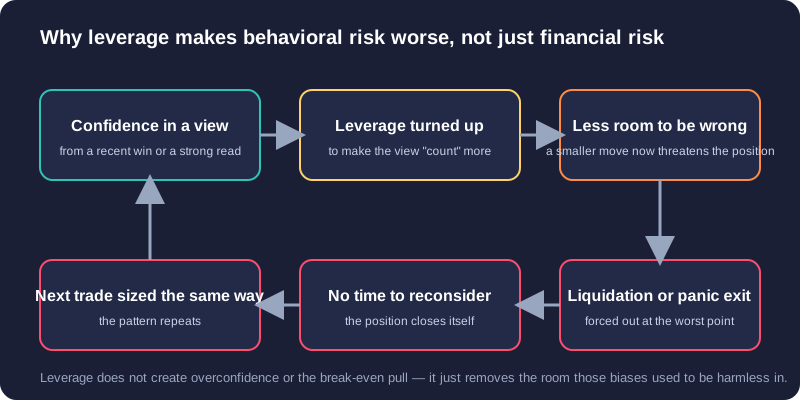
Lo, Repin and Steenbarger (2005) found that traders with stronger emotional reactions to gains and losses performed significantly worse. Leverage raises the stakes on every one of those emotional reactions — the same overconfident or revenge-driven decision costs far more, far faster, when it's sized at 20x instead of 2x.
How to actually manage leverage risk
- Size the position from your stop-loss distance, not from how much margin the exchange will let you use. Decide the dollar amount you're willing to lose first; leverage and position size follow from that, not the other way round.
- Treat maintenance margin and funding fees as real costs that move your liquidation price closer than the simple 100%-÷-leverage math suggests — check the exchange's actual maintenance margin table, not just the headline leverage.
- Cap leverage well below the maximum offered. Most of the research above is about accounts using leverage far higher than a stated "buy-and-hold" thesis needs — 5x or 10x is already high enough to end a session on an ordinary hourly move.
- Test the leverage level before you risk it. A Strategy Lab check across optimistic, base and pessimistic scenarios shows what a given leverage does to your drawdown before any of it is real.
How Holdy helps you practice this without the cost of finding out live
This is exactly the gap between reading the math and feeling it under pressure. Trader Day includes a Leverage Stress Test scenario built specifically around this: it's designed to trigger — and let you observe — the leverage and liquidation patterns described above, in a session where the cost of being wrong is nothing.
Strategy Lab lets you set a leverage level and run it through optimistic, base and pessimistic scenarios before you ever risk it, so the arithmetic in the chart above becomes a number attached to your actual plan, not an abstract formula. And because Holdy records what you set against what you did, Plan vs Execution compares the leverage you declared in Strategy Lab with the leverage you actually used in Trader Day — so if pressure pushes your real leverage above your stated plan, that gap shows up as evidence in your profile instead of staying invisible until a liquidation makes it obvious.
Educational content, not financial advice. Leveraged crypto trading carries a high and well-documented risk of loss, including the loss of your full position.
Sources
- ESMA (2018), Product intervention measures on CFDs and binary options
- Qin, Zhou, Gamito, Jovanovic & Gervais (2021), An Empirical Study of DeFi Liquidations, ACM Internet Measurement Conference
- Alexander, Deng & Zou (2021), Hedging with Bitcoin Futures: The Effect of Liquidation Loss Aversion and Aggressive Trading
- Lo, Repin & Steenbarger (2005), Fear and Greed in Financial Markets, American Economic Review
- Thaler & Johnson (1990), Gambling with the House Money and Trying to Break Even, Management Science
See your own patterns
Play a free simulated trading session and get a behavioral debrief — no signup, no real money.
Start Trader DayKeep reading
Holdy Lab content is educational and is not financial advice. Simulated results do not predict real results.